
What Really Matters in Zero-Shot Image Captioning?
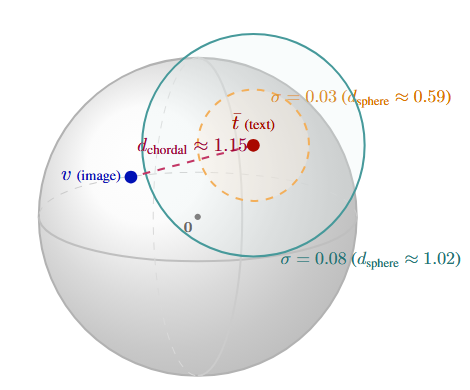
We study the task of generating image captions from visual features without training on paired images, known as zero-shot or text-only captioning. Because contrastive models such as CLIP place visual and textual representations into distinct subspaces (the modality gap), text decoders trained purely on text cannot directly ingest visual features from the same contrastive space. To overcome this gap, existing methods rely on complex machinery, including external text memory banks, synthetic image generation, or iterative latent diffusion models.
In this paper, we conduct a systematic empirical dissection to isolate the core ingredients sufficient for effective zero-shot captioning. We show that strong cross-modal alignment can be achieved without generative diffusion or visual inversions. Instead, two simple ingredients are sufficient: (1) training on averaged multi-caption representations, which filters out incidental syntactic variance and isolates shared visual semantics; and (2) denoising corrupted text representations with isotropic Gaussian noise, which enables the mapper to bridge the modality gap.
Our minimalist framework, AlignCap, achieves state-of-the-art results among memory-free zero-shot methods on the MS-COCO Karpathy benchmark, reaching 101.7 CIDEr with a single-step joint training run (and 104.1 CIDEr with sequential adaptation) while operating in a single forward pass without the latency of iterative diffusion sampling.